Public Domain Day 2026 – new works entering the open access pool
January 1 is a special time for open culture and science – countless works of art, texts, films, and musical compositions enter public domain pool of for unrestricted use.
In most European Union countries, January 1st – Public Domain Day – marks the expiration of copyright protection for works whose creators passed away 70 years ago (today – of those who passed away in 1955). That means we gain the freedom to creatively reuse, distribute, and modify these cultural and scientific staples, giving them yet another venue to be appreciated and celebrated.
On January 28 (Wednesday), we will host a webinar regarding the use of open resources in the context of the large language model training industry and AI; we will reveal more details in the second week of January!
Below are some of the notable figures from the world of culture and science whose works and papers enter unrestricted, secondary circulation starting today. The list is, of course, not exhaustive; we encourage your own research and going down a rabbit hole of the wealth of public domain! In the upcoming New Year, we wish you openness, limitless imagination, and plenty of creative energy.
Art
- Fernand Léger (1881–1955) – Painter, sculptor, filmmaker. A giant of modernism whose works hang in the most important museums of the world, and whose work can be recognized by a characteristic style described as “tubism.”
- Zofia Stankiewicz (1862–1955) – Painter and graphic artist, one of the first Polish female graphic arts professional.
- Yves Tanguy (1900–1955) – Surrealist painter, known for dreamlike, boundless landscapes filled with biomorphic forms.
- Max Pechstein (1881–1955) – Painter, graphic artist, sculptor, leading German expressionist and member of the Die Brücke group.
- Maurice Utrillo (1883–1955) – Painter and graphic artist, representative of the École de Paris, creator of popular cityscapes depicting the French capital.
- Jerzy Kossak (1886–1955) – Painter of historical themes and motifs known from the ever popular works of his father (Wojciech Kossak) and grandfather (Juliusz Kossak).
- Nicolas de Staël (1914–1955) – Painter creating on the crossing of abstraction and figuration.
- María Izquierdo (1902–1955) – Painter and the first Mexican woman whose works were exhibited in the USA.
Although our list this year is dominated by painting and graphic arts, sculptures and various types of designs (fashion, architecture, or utility objects) also pass into the public domain.
Cultural heritage assets located in the Public Domain can be found, among others, in the digital repositories of numerous museums and galleries in Poland (e.g. Zbiory Muzeum Narodowego w Krakowie, Cyfrowe Muzeum Narodowe w Warszawie, Kolekcje Muzeum Warszawy, Otwarta Zachęta or wMuzeach.pl) and abroad (e.g. Rijksmuseum, Metropolitan Museum, Getty Museum, portal Google Arts and Culture). We would be remiss to not give an honorable mention to the great Wikimedia Commons.
Music
- Tadeusz Sygietyński (1989–1955) – A key figure for Polish folklore, founder of the ”Mazowsze” State Folk Ensemble of Song and Dance, composer, conductor, teacher.
- Charlie Parker (1920–1955) – Saxophonist and composer, his arrangements and performances are considered the foundation of modern jazz (alongside Dizzy Gillespie, he is considered one of the fathers of bebop).
- George Enescu (1881–1955) – Romanian composer, violinist, pianist, conductor, and teacher, one of the key figures of the musical world in the first half of the 20th century.
- Arthur Honegger (1892–1955) – Swiss composer of classical and film music, member of The Group of Six (Les Six).
- Marion Bauer (1887–1955) – Composer, lecturer, music critic.
Their works enter the public domain – meaning the sheet music of compositions or published texts, but not necessarily recordings of their performances. These are subject to separate related rights belonging to the performers of the artistic performance or the producers of the recording (audio or video). Musical materials in open access can be found, among others, on the website polish.musicsources.pl of the Fryderyk Chopin Institute, in Petrucci Music Library or the Internet Archive.
Literature
- Thomas Mann (1875–1955) – Novelist and essayist, winner of the Nobel Prize in Literature in 1929. Author of ”The Magic Mountain”, ”Doctor Faustus”, ”Buddenbrooks” and others.
- Lucyna Krzemieniecka (1907–1955) – Writer, poet, author of popular texts for children; some Poles may know her book ”From the Adventures of Hałabała the Dwarf” from the canon of school readings (the text was enriched by illustrations by Zdzisław Witwicki, which are still under copyright).
- Robert E. Sherwood (1896–1955) – Playwright, screenwriter, multiple Pulitzer winner, and even an Oscar winner (for best adapted screenplay for the film ”The Best Years of Our Lives” from 1946).
- José Ortega y Gasset (1883–1955) – Philosopher, essayist, author of the series of articles ”The Revolt of the Masses” (later published as a book).
- Wallace Stevens (1879–1955) – Poet, essayist, one of the key figures in modernist poetry.
- Dale Carnegie (1888–1955) – Writer, author of popular self-help books, including the 1936 bestseller ”How to Win Friends and Influence People”.
The texts entering the public domain are the original ones – meaning, their translations may still be covered by the copyright helf by translators. Texts and scans of various genres of literature (including scientific) from the Public Domain can be found in services such as Wolne Lektury, Kronik@, Federacja Bibliotek Cyfrowych, Polona, Europeana, The Internet Archive, and even in audio version on LibriVox.org (or, again, Wolne Lektury). Additionally, many educational materials published on Khan Academy are made available under Creative Commons licenses.
Science
- Albert Einstein (1879–1955) – Theoretical physicist, perhaps the most recognizable scientist in history, creator of the general theory of relativity. (Please note, what’s entering the public domain is his works, i.e. scientific publications or other writings – but not his image or photographs capturing him. For example, the famous photo by Arthur Sasse with Einstein sticking out his tongue is in the public domain in the USA, but, unfortunately, not in Poland).
- Alexander Fleming (1881–1955) – Bacteriologist, Nobel laureate, discoverer of penicillin, the first antibiotic, which changed the course of medicine.
- James B. Sumner (1887–1955) – Chemist, Nobel Prize winner for co-authorship of research on enzymes.
- Arthur Tansley (1871–1955) – Botanist, creator of the concept and term ”ecosystem”.
- Robert Williams Wood (1868–1955) – Experimental physicist, pioneer of infrared and ultraviolet photography.
- Edward Kasner (1878–1955) – Mathematician, popularized the name ”googol” (the number 10 to the power of 100), which his then-9-year-old nephew invented. This number is precisely where the search engine Google’s name comes from.
- Alfred Radcliffe-Brown (1881–1955) – Social anthropologist, co-creator of structural functionalism (a perspective in sociology and anthropology that views society as a system consisting of connected parts).
- Louis Leon Thurstone (1887–1955) – Psychologist, pioneer of psychometrics, creator of methods for measuring intelligence (IQ) and attitudes (Thurstone scale).
How to use the Public Domain, what is allowed and what is not?
The public domain is a collection of materials that can be used without restrictions. Photos, paintings, music, and texts from the public domain can be freely modified, translated, copied, and distributed without paying license fees, even if we want to use the content for commercial purposes. This is because the economic copyrights to the works contained in the domain have expired or the materials were never subject to copyright. You also have the right to earn money on derivative works (i.e., your own creativity) that were created based on resources from the public domain.
There is no single, global copyright law, so there is also no uniform collection of ”public domain”. Here is what it looks like currently in the most common cases:
- Most of the European Union (including Poland), United Kingdom, most of South America:
- Works enter the public domain 70 (full) years after the death of the creator.
- On January 1, 2026, works of creators who died in 1955 enter the public domain.
- Most countries of Asia and Africa:
- Works enter the public domain 50 (full) years after the death of the creator.
- On January 1, 2026, works of creators who died in 1975 enter the public domain.
- United States of America (USA):
- Works enter the public domain 95 (full) years from the date of publication (for works published between 1923 and 1977).
- On January 1, 2026, works published in 1930 enter the public domain.
Important rule for calculating when the protective period ends: The expiration of copyright protection applies to works whose creators died a specific number of full years earlier. For example: in Poland, if a creator died on June 15, 2000, the protection period of 70 years is counted only from January 1, 2001, and this person’s works will enter the public domain on January 1, 2071.
When using a work from the public domain or covered by a Creative Commons license, remember to:
- Credit the author and title of the original (because although economic copyrights have expired, the content is still covered by moral rights),
- Respect the integrity of the work (respecting intended values behind the work),
- Verify the work’s public domain status. Materials published on the internet are, unfortunately, sometimes labeled incorrectly; one should also verify information provided by large language models (i.e., AI tools such as ChatGPT or Gemini), which can hallucinate an incorrect date of death for the creators we inquire about.
Materials that can be freely used in your work can most often be recognized by markings such as:
|
CC0 licence
|
Public Domain symbol
|
Creative Commons licence*
|



*Note: The Creative Commons label may be accompanied by additional icons that specify usage conditions, such as attribution requirements, prohibitions of commercial use, or restrictions on creating derivative works (e.g., “remixes” like artistic collages). For more details on individual Creative Commons licenses and related rights, visit CreativeCommons.org.
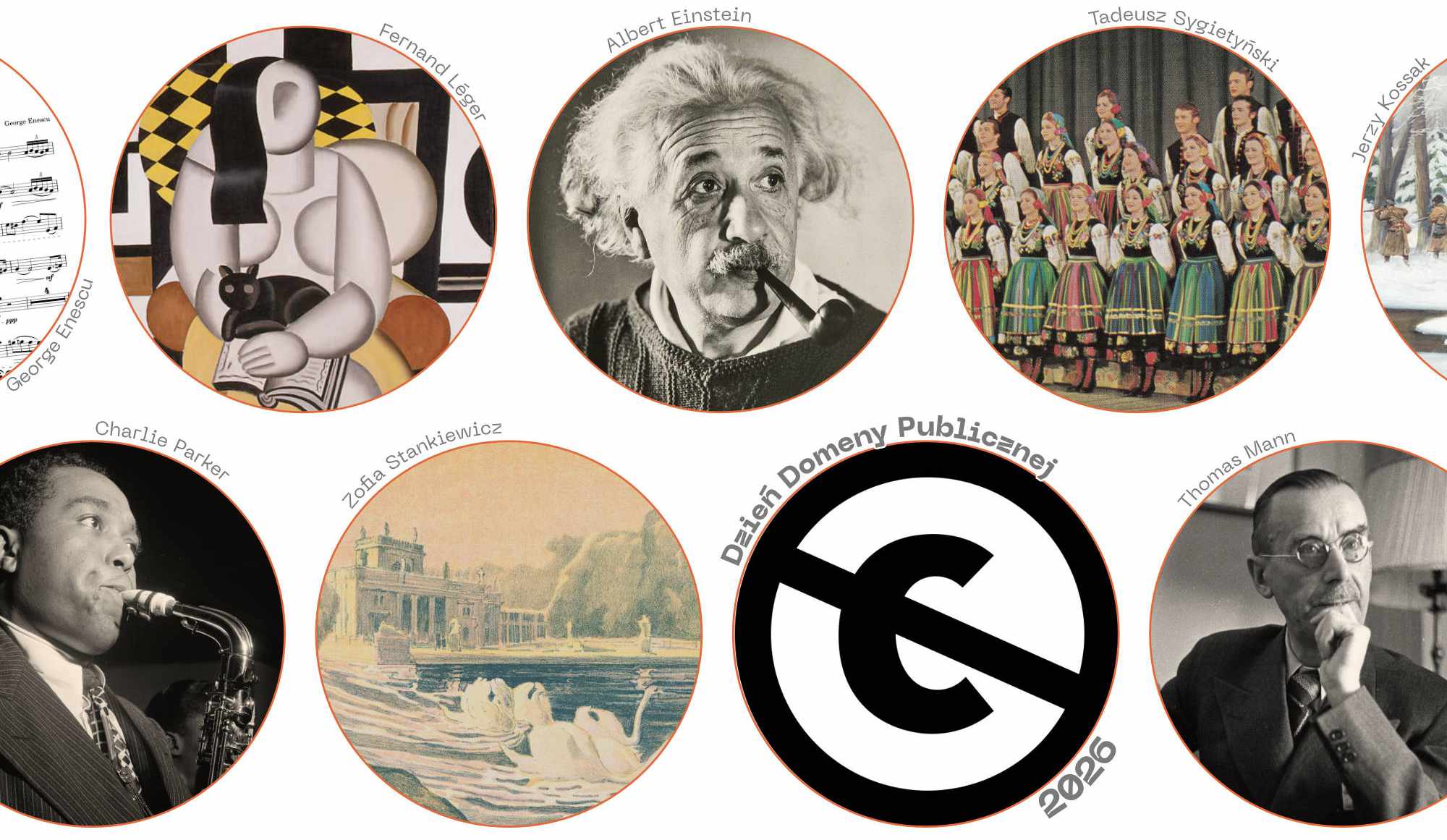
In our main image, we used following works from the public domain:
George Enescu, sheet music to ”Romanian Rhapsody no. 1”, 1901.
Fernand Léger, ”Woman with a Cat”, 1921, Metropolitan Museum of Art. [source]
Albert Einstein, 1942, Joods Cultureel Kwartier. [source]
Dionizy Gładysz, Państwowy Zespół Pieśni i Tańca ”Mazowsze”, before 1975. [source]
Jerzy Kossak, ”Zimowy patrol”, 1939. [source]
William P. Gottlieb, portrait of Charlie Parker, 1947. [source]
Zofia Stankiewicz, ”Łazienki”, 1935, Muzeum Warszawy. [source]
Los Angeles Daily News, Thomas Mann, 1925/1945. [source]