New ”Barriers to Research” report
We examined how EU copyright law does (not) support researchers, with a new methodology and an accompanying metric: the Index of Research Exceptions (I-REx).



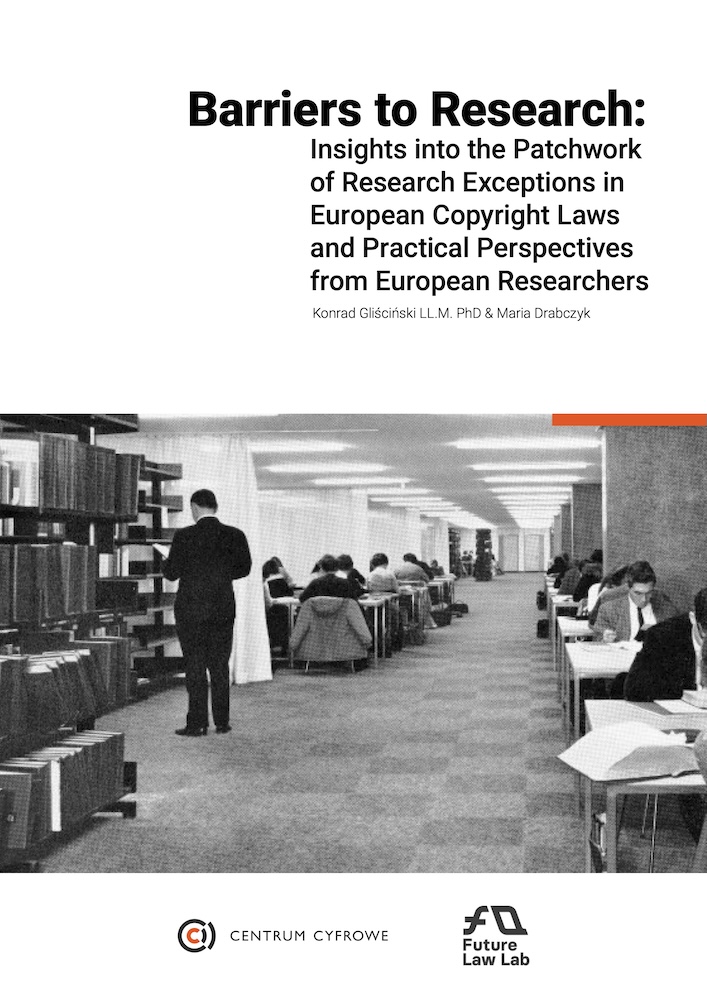
The freedom to conduct scientific research is the foundation for the development of knowledge and innovation. In practice, however, European researchers often encounter barriers resulting from fragmented, inconsistent copyright regulations. Barriers to Research: Insights into the Patchwork of Research Exceptions in European Copyright Laws and Practical Perspectives from European Researchers is a report prepared by Centrum Cyfrowe in cooperation with the Future Law Lab of the Jagiellonian University, published with the support of Knowledge Rights 21 and COMMUNIA.
Our study shows that, despite a common EU framework, regulations regarding copyright exceptions and limitations for scientific research purposes remain highly diverse. The analysis covers 28 European countries and introduces a new index – I-REx (Index of Research Exceptions), which enables the assessment of the extent to which national copyright systems support research activities. The results indicate that most Member States have implemented research exceptions in a more restrictive manner than required by EU law.
The report combines a comparative legal analysis with the experiences of researchers themselves. Based on interviews with individuals from 11 countries and case studies, the authors – Konrad Gliściński LL.M. PhD and Maria Drabczyk leading the works – show that inconsistent regulations hinder international cooperation, access to research materials, data utilization, and the conduct of research using AI tools and text and data mining (TDM). Researchers often operate under conditions of legal uncertainty, and complex regulations combined with a lack of appropriate institutional support make copyright issues an additional burden in scientific work. Some researchers consciously ignore these regulations, prioritizing the value of collaboration, the need for further scientific development, and the fulfillment of their research mission.
A key conclusion of the report is the need for further harmonization of copyright law at the European Union level and the creation of a stronger, uniform exception for scientific research purposes. The authors point out that providing researchers with greater legal certainty is essential for the development of open science, cross-border cooperation, and effectively harnessing the potential of digital technologies in research.
 |
Authors:
Konrad Gliściński LL.M. PhD (Principal Investigator) Maria Drabczyk Ewa Laskowska-Litak LL.M., dr hab. Krzysztof Siewicz PhD Katarzyna Strycharz Anna Buchner PhD Katarzyna Fereniec Klaudia Grabowska |
This study’s qualitive research was carried out in partnership with Ciekawość.
The data used in the report was gathered and analysed thanks to the support of Knowledge Rights 21. Its publication was made possible thanks to COMMUNIA. Both funded by Arcadia – a family charitable foundation.
Powiązane


Autor: Koncern Ilustrowany Kurier Codzienny – Archiwum Ilustracji / Narodowe Archiwum Cyfrowe